

It all starts with a conversation
It’s time to stop treading water and build confidence with a better performing business.
23 Hamilton St,
Subiaco WA 6008
It’s time to stop treading water and build confidence with a better performing business.
23 Hamilton St,
Subiaco WA 6008
Facing a financial or medical crisis is incredibly stressful, and the complex rules around superannuation can make it feel even more overwhelming. You might be wondering, "can I access my super early?" and looking for a clear, straightforward answer. While super is designed for retirement, there are very specific and limited circumstances where you can access it sooner.
This guide will walk you through the strict Australian rules for early superannuation access, explain the application process, and highlight the long-term financial impact so you can make an informed decision.
Disclaimer: The information provided in this article is for general purposes only and does not constitute financial advice. Your situation is unique, and the rules surrounding superannuation are complex. We strongly recommend you seek professional advice by speaking with a registered financial advisor before making any decisions.
Before looking at the exceptions, it’s important to understand the standard rules. Superannuation is your nest egg for the future, not a regular savings account. It’s designed to be preserved for your retirement.
Normally, you can access your super when you meet a ‘condition of release’. The two most common conditions are:
Your preservation age is the minimum age, set by law, at which you can access your super if you are retired. It is not the same as the Age Pension age. Your preservation age depends on when you were born.
| Your Date of Birth | Your Preservation Age |
|---|---|
| Before 1 July 1960 | 55 |
| 1 July 1960 – 30 June 1961 | 56 |
| 1 July 1961 – 30 June 1962 | 57 |
| 1 July 1962 – 30 June 1963 | 58 |
| 1 July 1963 – 30 June 1964 | 59 |
| From 1 July 1964 | 60 |
This date is the first key to unlocking your super under normal retirement rules.
The term ‘retirement’ has a specific definition when it comes to super. You are considered retired if:
If you haven’t met a normal condition of release, you can only access your super in very limited circumstances. The Australian Taxation Office (ATO) and your super fund assess these applications on a case-by-case basis, and you must provide strong evidence to support your claim.
The main conditions for early release include:
You may be able to withdraw some of your super on compassionate grounds for specific, unpaid expenses. These include:
Applications for compassionate grounds are made directly to the ATO.
To be eligible for early release due to severe financial hardship, you must meet strict criteria. Specifically, you must prove that:
Under these rules, you can typically withdraw one lump sum of between $1,000 and $10,000 in any 12-month period. This application is made to your super fund, not the ATO.
If you are diagnosed with a terminal medical condition, you can access your entire super balance as a tax-free lump sum. A terminal medical condition is defined as one where two registered medical practitioners have certified that the illness or injury is likely to result in death within 24 months. At least one of these practitioners must be a specialist in the area related to the illness or injury.
If a physical or mental medical condition causes you to stop working, or to work fewer hours, you may be able to access your super.
The application process is different depending on your reason for applying. Gathering the correct documentation is the most critical and often time-consuming step.
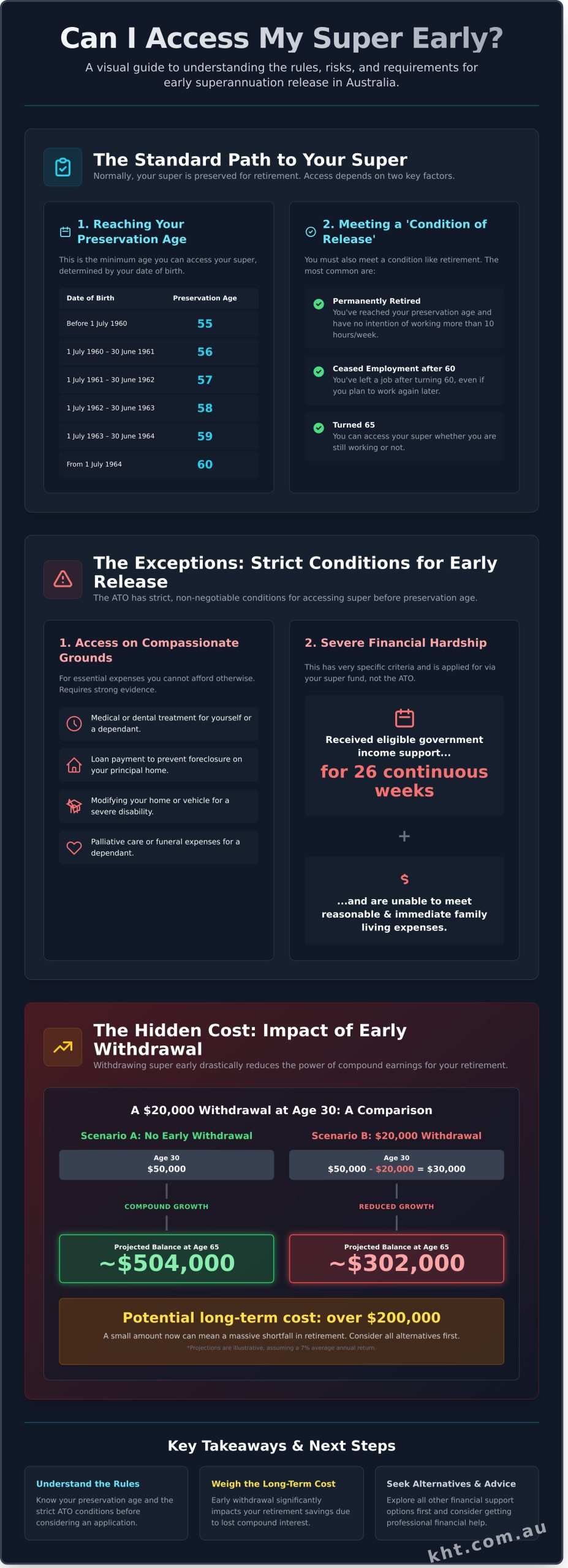
Making the decision to access your super early is effectively borrowing from your future self, and it comes with significant long-term costs. It should always be treated as a final option after all other avenues have been exhausted.
Withdrawing from your super early doesn’t just reduce your balance today; it erases decades of potential future growth. The power of compound earnings means that even a small amount withdrawn now can have a massive impact on your final retirement figure.
Many super funds provide default Life, Total and Permanent Disability (TPD), and Income Protection insurance. These policies are a vital safety net. However, if your super balance drops below a certain amount (often $6,000) or your account becomes inactive, your fund may automatically cancel your insurance cover—potentially leaving you without protection when you need it most.
Unless you are accessing super for a terminal medical condition, the money you withdraw will likely be taxed. This is taxed as a lump sum, and the rate depends on your age and the components of your super balance. This can be a significant and unexpected cost, reducing the amount of cash you receive.
Before you touch your super, it’s critical to explore all other available options. Navigating financial hardship is stressful, and you don’t have to do it alone. Seeking professional advice can provide a structured plan and the clarity you need to regain control.
If you are feeling overwhelmed and unsure about the rules or the right path forward, a financial advisor can help. They can work with you to:
Facing financial uncertainty is tough, but a clear plan is the first step toward getting back on track.
Facing financial uncertainty? A clear plan is the first step. Book a meeting with a KHT advisor.
How much money can I withdraw from my super early?
This depends on the condition. For severe financial hardship, it’s typically between $1,000 and $10,000. For compassionate grounds, it’s limited to what you reasonably need to cover the specific expense. For a terminal medical condition or permanent incapacity, you can usually access the full balance.
How long does the early super release process take?
Processing times vary significantly. Applications to the ATO for compassionate grounds can take several weeks, plus additional time for your fund to process the payment. Hardship applications to your fund may be quicker but depend on the fund’s internal processes.
Will accessing my super early affect my Centrelink payments?
Yes, it can. A super withdrawal is counted as income by Centrelink and may reduce or cancel your payments for a period. It’s essential to check with Services Australia before you apply.
What happens if my application for early release is rejected?
If your application is rejected, you will receive a reason for the decision. You may be able to appeal the decision or re-apply if your circumstances change or if you can provide new evidence.
Are there any specific COVID-19 early release of super rules still active?
No. The COVID-19 early release of super program ended on 31 December 2020 and is no longer available.
Can I access my super to buy a house or pay off a credit card?
Generally, no. You cannot access your super early to pay for a deposit on a home (except through the First Home Super Saver Scheme, which has its own rules) or to pay off general debts like credit cards or personal loans. The conditions are strictly limited to those outlined by the ATO.
The information contained on this website is intended for general informational purposes only and does not constitute financial, tax, or legal advice. While KHT endeavours to keep the information up-to-date and correct, we make no representations or warranties of any kind, express or implied, about the completeness, accuracy, or reliability of the information. Any reliance you place on such information is strictly at your own risk.